What is Checksum AI?
AI coding tools are everywhere. Teams are shipping 5–10x more code than a year ago — but quality can’t keep up. AI-generated code doesn’t get reviewed the same way. Engineers are still the bottleneck: review, test, prompt, wait, repeat. And 10x more features means 10x more bugs. Checksum is a continuous quality platform. AI for coding needs AI for quality. Checksum’s E2E Testing Agent works autonomously — it detects what needs testing, generates production-ready Playwright tests, runs them in your CI, and automatically heals them when your app evolves. By the time an engineer sees the code, it’s already verified. What you get:- Pure Playwright test code delivered to your repository as pull requests
- No vendor lock-in — you own the tests and can run them anywhere. Tests are just pure Playwright.
- Zero-maintenance test suites that heal themselves
- From zero tests to thousands in days, not months

How It Works
Checksum follows a continuous loop:- Setup — Connect your repository and configure your testing environment (Getting Started)
- Detect — Checksum analyzes your application and identifies the most important test flows (Detect Tests)
- Generate — An AI agent generates Playwright E2E tests and delivers them as PRs (Generate Tests)
- Run — Execute tests locally or in CI using the Checksum CLI. Reports auto-upload to the dashboard, and the CLI includes auto-recovery that attempts to fix failing tests in real time. Fully compatible with Playwright — tests can also be run with Playwright directly. (Checksum CLI)
- Heal — When tests break due to app changes, Checksum automatically fixes them and opens PRs (Auto-Maintenance)
- Monitor — Track test health, triage issues, and get notified (Health Dashboard)
Key Concepts
Collections
Groups of related test flows. For example, you might have collections for “Checkout”, “User Management”, or “Settings”. Collections help you organize and manage your tests by feature area.Test Flows (User Stories)
Individual test scenarios within a collection. A test flow describes a specific user journey — like “User can create an account” or “Admin can export a report”. Test flows are what Checksum generates tests for.Test Generation
The process where Checksum’s AI agent creates Playwright test code from a test flow definition. Generation runs through a multi-phase pipeline that plans, implements, reviews, and verifies the tests before delivering them as a PR.Agent Sessions
A running instance of the AI agent working on your tests. When you trigger detection, generation, or healing, Checksum creates a session that you can monitor, interact with (answer questions), and track to completion.Test Runs
Execution results from running your tests via the Checksum CLI. Each test run captures pass/fail/healed counts, videos, screenshots, and Playwright traces for debugging.Auto-Healing
Automatic repair of broken tests when your app changes. When tests fail in CI, Checksum creates a healing session that fixes the issues (selector drift, timing, assertion mismatches) and opens a PR with the fixes.The Checksum Web App
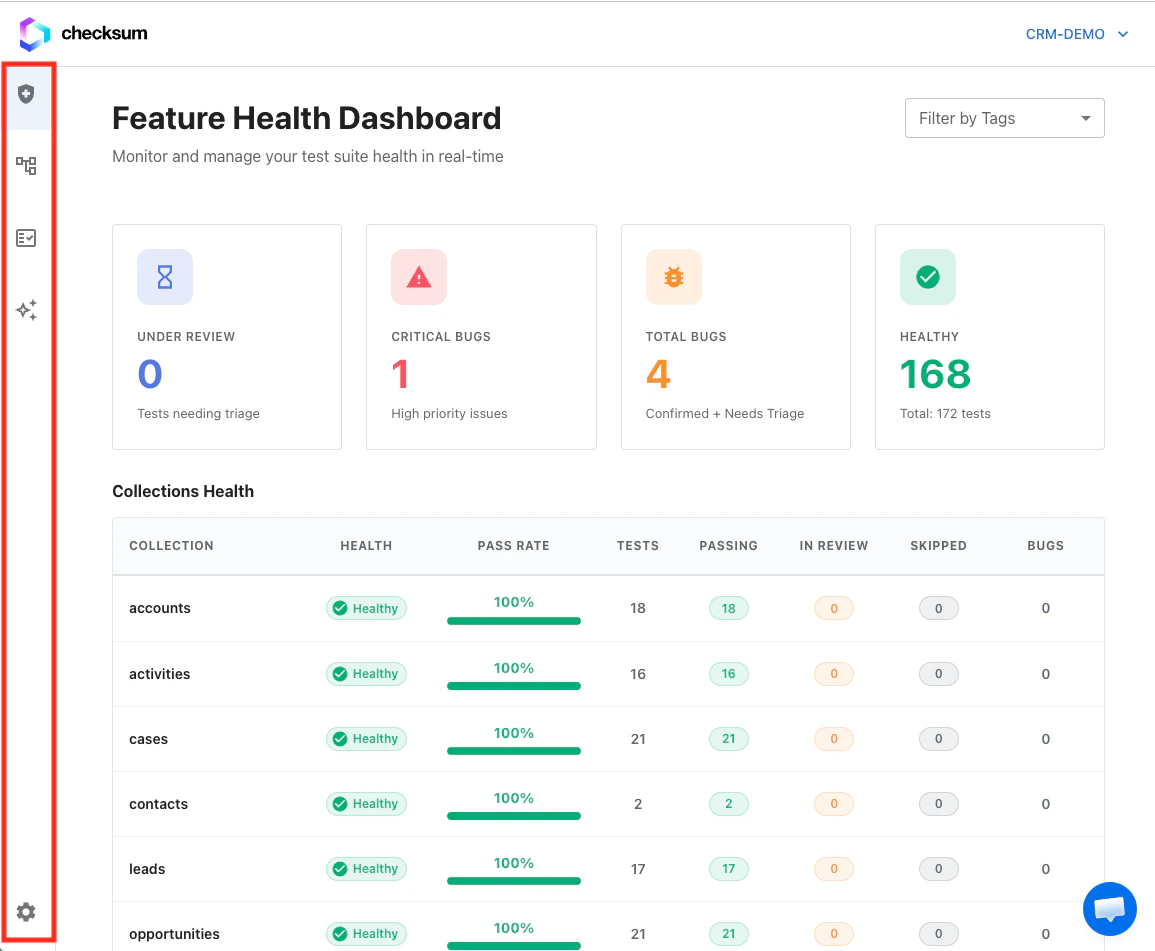
Powered by Checksum’s world model — built from real user behavior patterns — the agent achieves ~97% test accuracy, producing fully architected tests with data setup, cleanup, and grounded selectors. The Checksum web app at app.checksum.ai is your central dashboard for managing everything. It has three main sections:- Test Generation — Manage collections, test flows, and trigger test generation
- Test Results — View test run results, reports, and debugging traces
- Feature Health Dashboard — Monitor test health across your suite, triage bugs, and get notifications
- Agent Sessions — Track running AI agent sessions and interact with them
- Settings — Configure environments, git integration, and team members